
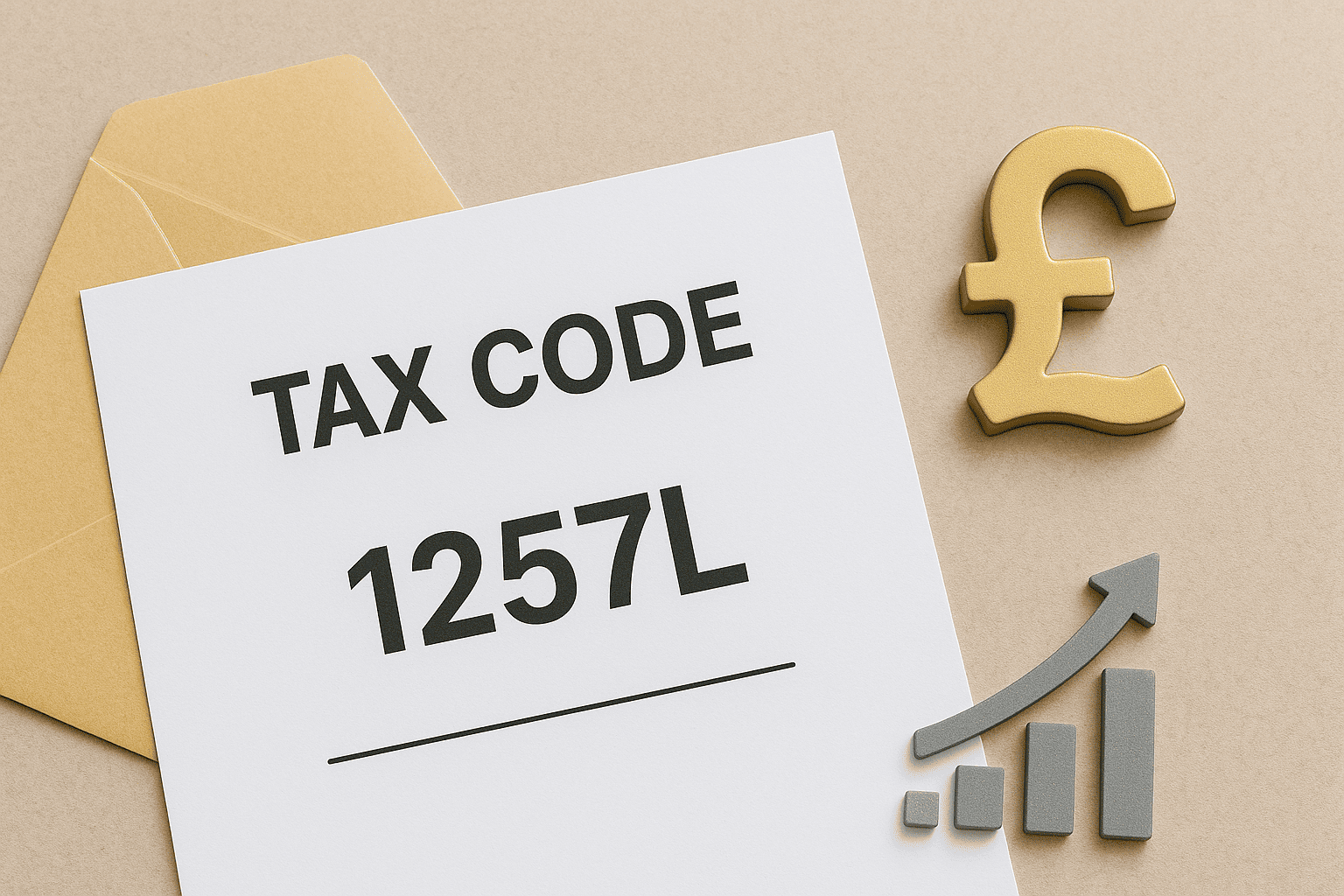
Your tax code is a short instruction issued by HMRC to your employer, telling payroll how much of your income to treat as tax free before deducting anything. It is not a calculation of what you owe and it carries no authority of its own. It is an estimate, applied in advance, and estimates can be wrong.
The standard code for the 2026/27 tax year is 1257L, which corresponds to the £12,570 personal allowance. Almost everything else is a variation on that theme.
Reading the number
Multiply the number by ten and you have your tax free allowance for the year. 1257 becomes £12,570. A code of 1000L means £10,000 tax free, usually because something has been deducted from the standard allowance.
Payroll then spreads that allowance across the pay periods. On a monthly payroll, 1257L gives you £1,047.50 of tax free pay each month, and everything above it is taxed at the applicable band.
The number falls below 1257 for several reasons: a company car or private medical cover being taxed through payroll, an underpayment from a previous year being collected in instalments, or untaxed income such as rental profit being coded out. It rises above 1257 when you have allowable expenses, professional subscriptions or a marriage allowance transfer.
Reading the letter
Scottish taxpayers carry an S prefix, Welsh taxpayers a C prefix. These change which rate table applies, not the allowance itself.
The K code, which works backwards
A K code is the only one where the number is added to your taxable pay rather than removed from it. K475 means £4,750 is treated as additional taxable income across the year. It appears when taxable benefits, an untaxed pension or a large underpayment exceed the personal allowance entirely.
There is a statutory limit: no more than half of your gross pay can be taken as tax through a K code in any pay period. Anything beyond that is carried forward, which is worth knowing when a K code appears and the deduction still looks impossible.
Week 1 and month 1: the non-cumulative flag
A code followed by W1, M1 or X is being applied non-cumulatively. Instead of recalculating your position for the whole year at each pay run, payroll treats every period in isolation and gives you one twelfth of the allowance regardless of what has happened so far.
This is standard after a job change where the previous employment details have not arrived. It nearly always overtaxes, because it ignores any allowance you have not yet used. It is also the mechanism behind emergency tax, and it resolves itself once a cumulative code is issued.
Why codes change without warning
- A benefit in kind was added or removed. Employers report company cars, medical cover and interest free loans, and HMRC adjusts the code mid-year to collect the tax.
- An underpayment is being collected. HMRC prefers to recover small debts through the code rather than issuing a demand. The debt is real but the timing is theirs.
- An estimate was updated. If HMRC believes your income has risen, it may reduce your allowance to protect against a shortfall. Estimates are frequently based on a single unusual month.
- You started a second job. The second employment usually receives BR or D0, because the allowance is already in use at the first.
- You crossed £100,000. The personal allowance tapers away between £100,000 and £125,140, and the code moves towards 0T as it does. That taper produces the effective 60% band described in the £100,000 tax trap.
Checking whether yours is right
- Find the code on your latest payslip and compare it with the coding notice HMRC sent. If you never received one, the code may be a payroll default rather than an HMRC instruction.
- Check for deductions in the notice you do not recognise. Benefits you no longer receive are the most common stale entry.
- Compare your year to date tax against what your salary should produce for the periods elapsed. A tool such as the UK calculator gives the annual figure to scale from.
- If the code is wrong, contact HMRC rather than your employer. Payroll cannot change a code on request; it can only apply what it is given.
Overpaid tax within the current year corrects itself automatically once the right code arrives, because PAYE is cumulative. Overpaid tax from a closed year needs a claim, and the window for that is four years.
Work out what your deductions should look like at your salary with the UK Salary Calculator, then compare it against the payslip in front of you.
Related: What £50,000 leaves after tax